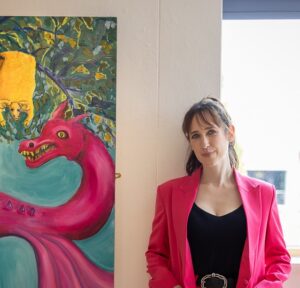
Sam Naughton
Productivity Tip:
Give Yourself a Fresh Perspective
Ever find yourself going over the same problem without getting anywhere? Sometimes a fresh prompt can help you approach it differently.
Sam Naughton, this week’s featured guest, draws an oracle or tarot card each morning. ✨
“I’m not doing it to predict the future, because nobody can do that, but I really enjoy the way it encourages me to look at something from a different perspective.”
For Sam, the cards offer a way to interrupt familiar thinking patterns. “Drawing a card gives me a prompt to think differently, consider another interpretation, or ask myself a question I might not otherwise have asked.”
If cards seem unusual, there are other ways to try this. You can use a journal prompt or write a few questions on slips of paper: What am I assuming? What would I tell a friend in this situation? What’s another way to look at this?
Next time you’re stuck, try answering a different question instead of going over the same one again.




Routine Breakdown
Sam Naughton, Founder & CEO of Cocoon Healthcare
Tea, Tarot and Time to Think: A Healthcare Founder’s Morning

After more than 20 years in communications, including at Yorkshire Tea, Sam Naughton made a deeply personal career change. Losing her baby Willow at 10 weeks inspired her to found Cocoon Healthcare in 2024, offering the compassionate care she had needed herself.
Now balancing the Harrogate clinic with raising two children, Sam relies on simple habits to stay grounded – starting with a proper cup of tea. ☕
The Routine:
- Wakes up around 5–6 a.m. with her son. “My four-year-old son Alby is an early riser and we still co-sleep, so my mornings generally begin whenever he decides it’s time to get up. Having a young child means the start of my day isn’t entirely mine to organize, and I’ve learned to work around that rather than trying to force some ideal morning routine onto family life.”
- Makes a cup of tea. “I start every morning with a cup of Yorkshire Tea, and it absolutely has to be Gold. It’s the one part of my morning routine I’m not prepared to negotiate on. There’s something very comforting about having that familiar ritual before the day properly begins.”
- Gets her thoughts together while Alby watches cartoons and has breakfast. “I make notes, look at what needs my attention, or get something out of my head from the day before. I’ve learned that I don’t always need to solve everything immediately. Sometimes just writing something down, acknowledging that it’s on my mind and deciding what I can actually do about it is enough to help me move forward.”
- Draws an oracle or tarot card. “It’s a small habit, but I find it surprisingly useful. I’ve never been particularly interested in having a rigid, prescriptive routine, but I do like having little moments that encourage me to stop and think rather than just rushing straight into the next thing.”
- Leads the team at Cocoon Healthcare. “We have incredibly experienced clinicians and practitioners, and I’m very conscious that my role is to support them in delivering the kind of care we all believe in.”
- Makes time for Yin yoga on days away from the clinic. “I like to book time with @yogabynadry. Yin yoga gives me an opportunity to be still, concentrate on how I’m feeling, and let go of some of the tension I’ve been carrying.”
Why it works:
- Small rituals really can be comforting and even anxiety-reducing — possibly why that first cup of tea feels so grounding.
- Planning clears some headspace. Studies suggest that deciding how to tackle unfinished tasks can help stop them interrupting your thoughts.
- Sam lets her team’s expertise shine by focusing on supporting her clinicians so they can deliver the care her patients need.
- A small randomized trial found that five weeks of Yin yoga helped improve anxiety and sleep problems in stressed adults.
“The biggest thing I’ve learned is that a routine has to work around your actual life,” says Sam. “I don’t want to spend all my time chasing the perfect routine or worrying that I’m not doing enough. I want to be present for my children, look after the people around me, and keep building something that genuinely matters to the families who come to us.”